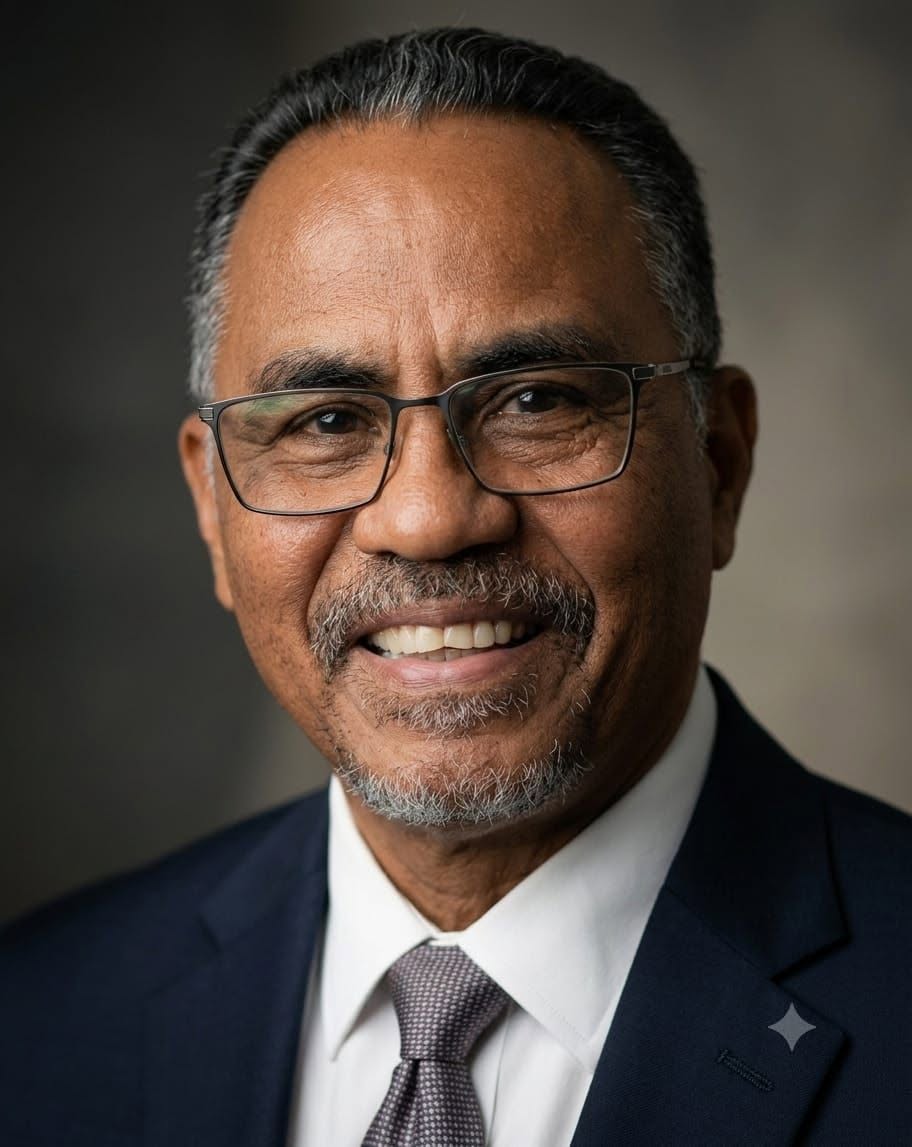
By: Ian Yhap, August 17, 2026
Prelude – The Sad Night Before
Before I answer Dr. Fahnbulleh’s “In the Midst of It All, Part II”, I need to say something that surprised me.
Listening to Dr, Fahnbulleh’s testimony before the Truth and Reconciliation Commission did not make me angry. It made me sad. The further I listened, the less interested I became in who had won some argument forty or fifty years ago.
I kept hearing moments when our history might have turned differently. Moments when someone might have stopped. Someone might have reconsidered. Someone might have said that however righteous the grievance, perhaps this particular road was becoming too dangerous.
The Rice Demonstration or Rice Riot troubles me especially.
Dr. Fahnbulleh tells the TRC that before April 14 he asked Baccus Matthews what would happen if the government opened fire. He says intelligence had reached him that blood was being moved from the blood bank to the hospital. He says he left one meeting wondering whether Matthews was a reckless gambler. And still, the movement went forward.
The government fired. The responsibility for firing belongs to the government.
But another question has begun to bother me. If some of the people organizing the resistance already feared that bullets might come, could something have been done differently?
We said we were fighting for the masses. Yet too often it was the masses who were sent to the front lines to face the bullets. The leaders had ideas. The people had bodies. That is a painful thought.
Dr. Fahnbulleh himself says it would be dishonest to pretend that MOJA was not involved in April 14. He says plainly that he participated, that he was a member of the Central Committee and that he had been delegated to engage the PAL leadership.
I respect that admission because it makes the tragedy human. These were not invisible historical forces moving across a chessboard. They were men making choices in circumstances they knew were dangerous.
Then came April 12, 1980. The old order fell and almost immediately, more blood. Thirteen men were taken to the firing squad.
Dr. Fahnbulleh tells us that his father came into his office and warned him: “Now you are in it.” His father understood something very early. Whatever promise the new order carried, executions would stain it. He condemned the spectacle and warned that the people would one day ask those who had entered the new government to explain.
How different might our history have been if more people had listened to that old man?
Then exile. More organizing. More grievances. More militants. More military thinking. More plots. More deaths. Some militants died in Sierra Leone. Some later moved toward the NPFL. Others disappeared into the long geography of Liberian exile and war.
At one point Dr. Fahnbulleh says, almost matter-of-factly, “But so is the nature of the struggle.”
That sentence should stay with us.
When did the lives of ordinary Liberians become part of the expected cost of “the struggle”? At what point did we begin accepting death as the natural punctuation of political disagreement? And when did everybody become so certain that history had left them no other choice?
For years we have heard that the tragedy of Liberia was that the dust was never allowed to settle.
I have begun to look at that expression differently. Dust does not rise by itself. Somebody kicks it and when it begins to settle, another person can kick it again.
The old order kicked up dust through exclusion and resistance to change. The Progressives kicked up dust in challenging it. The government responded with force. The coup kicked up more. The executions kicked up more. Doe’s repression kicked up more. Exiles organized. Soldiers trained. Coups were attempted. Movements fractured. Guns crossed borders. Taylor invaded.
And through it all, each generation explained that the dust it raised had been forced upon it by the dust raised before.
That is what makes me sad. Because somewhere in that chain somebody had to say: enough. Somebody had to refuse the inheritance. Somebody had to decide that being wronged yesterday did not require another Liberian to die tomorrow.
Instead, we kept finding historical reasons why the next confrontation was unavoidable. We fought for the people. We liberated the people. We avenged the people. We organized the people. And again and again, it was the people who died.
That is the sadness I carried with me as I listened to the TRC testimony.
It is also why I was never particularly interested in assigning Dr. Fahnbulleh all the blame, or absolving the old order of its failures, or putting anybody on trial through Facebook. I am interested in something simpler.
Where were the exits? Where could Liberia have taken another road? Who saw the danger before it came? Who warned against it? Who proceeded anyway? And why?
Those are the questions that should matter to future generations because if all we teach them is who was right and who was wrong, they may inherit our arguments. And the arguments could continue for eternity.
If we teach them where we could have stopped the tragedy and did not, perhaps they may inherit something more useful.
Wisdom!
FAHNBULLEH MEETS FAHNBULLEH
I approached Dr. H. Boima Fahnbulleh’s In the Midst of It All, Part II with considerable anticipation. There is something about its tone, its sweep, and perhaps even its placement after everything that preceded it that suggests the Doctor regards this as something of a closing argument.
The philosophical artillery has certainly been rolled onto the field. We have consciousness, social forces, modes of production, class interests, colonialism, African liberation, Fanon, Nkrumah, Lenin and the movement of history itself. One gets the distinct impression that the orchestra has assembled for the finale and that, somewhere beyond the last paragraph, the Doctor may already be warming up for the victory lap.
There is only one problem. We have all heard this song before but we just are not recognizing it.
Once we remove the philosophical wrapping and go back through Dancing on the Edge, Where Ignorance Is Bliss, the recently rediscovered Will the Real Ian Yhap Please Stand Up?, and now In the Midst of It All, we discover that much of Part II does not really present a new argument. The vocabulary changes. The scenery changes. But the argument largely does not.
That deserves to be said because Dr. Fahnbulleh has been doing this extraordinarily well for maybe over fifty years. He has an impressive command of language. He can take a fairly simple political proposition, dress it in revolutionary theory, introduce social forces and class contradictions, summon Fanon or Lenin for reinforcement, and send the proposition back into the world sounding considerably more profound than when it entered. Generations of young Liberians have been impressed by that style. Some, I suspect, have been mesmerized by it.
But difficult language is not necessarily deep thought, and simple language is not necessarily shallow thought. Sometimes the best service we can render an argument is to remove the decoration and see what is underneath. So that is what I propose to do here. I want to unmask the argument, not the man.
In Dancing on the Edge, questions arose about whether Dr. Fahnbulleh really knew me, whether my family relationships were relevant, whether I understood the politics in which he participated, and whether others were somehow behind my writings.
Then, in Will the Real Ian Yhap Please Stand Up?, the theory became more elaborate. Dr. Fahnbulleh announced that he knew the individuals who had supposedly written my article. Apparently, my terrible habit of referring to him sometimes as Henry Boima Fahnbulleh, sometimes as Boima Fahnbulleh, and sometimes as Dr. Fahnbulleh constituted security evidence of multiple authors. I also became a “puppet” and somewhere behind me there were “puppet masters” in the shadows.
Now in Part II, the puppet masters appear to have undergone professional development. They have become my “handlers.” And again, somewhere along the journey, we acquired a “motley collection of cheerleaders.”
The nouns change. The allegations do not.
There are mysterious people behind Ian Yhap. Who are they? After several articles, we still do not know. Dr. Fahnbulleh tells us that his security experience allows him to recognize patterns and culprits. He recognizes their modus operandi. He knows their prejudices. He apparently knows the interests they seek to protect.
Doctor, this investigation has been running for several articles now. At some point, shouldn’t security produce the suspects?
The same recycling occurs with my motives. Earlier, I was conducting an “inquisition,” trying to confirm prejudices and rectify history. Now Part II tells us that I, my alleged handlers and my cheerleaders are not interested in history at all. Instead, we seek “the dominance of certain prejudices” to protect our “narrow interests.”
What interests? Whose interests? What exactly am I trying to recover?
The True Whig Party disappeared forty-six years ago. I have never proposed restoring it. I have never defended one-party rule. I have repeatedly acknowledged its inequalities and failures. I have repeatedly said that the grievances against it were legitimate. Yet somehow, asking what happened afterward becomes evidence that I am defending what happened before. That argument is not new either.
And then there is the accusation that has persisted through almost the entire exchange: Ian Yhap is supposedly trying to make H. Boima Fahnbulleh responsible for Charles Taylor and the destruction of Liberia.
Dr. Fahnbulleh addressed this directly in Will the Real Ian Yhap Please Stand Up? He said that arguing that Fahnbulleh was involved in earlier revolutionary activity and therefore bears responsibility for the sequence that eventually produced Taylor and the war would be a non sequitur.
He is right. It would be a… whatever that word is… but there is only one small inconvenience.
I never made that argument.
Charles Taylor is responsible for Charles Taylor. Samuel Doe is responsible for Samuel Doe. William Tolbert is responsible for William Tolbert. H. Boima Fahnbulleh is responsible for H. Boima Fahnbulleh. Crime is not transferable.
My questions concern historical continuity, not transferred guilt. Who were the actors? Who trained whom? Who organized whom? Which networks existed? Where did people go when particular movements failed? Which relationships continued and which ones broke apart? What did the participants intend? What actually happened? What consequences followed, intended or unintended?
Those are historical questions. And something very interesting happened when I asked them. Dr. Fahnbulleh actually answered.
I asked who selected the Liberians sent through the Adult Literacy program. He answered. I asked who authorized some of them to receive military training in Ethiopia. He answered that too:
“The decision that few of them would take military training was the prerogative of the minister of education, in this case me…”
Well. Apparently the inquisition stumbled upon a historical fact. Before I asked, we did not have that answer. Now we do.
Dr. H. Boima Fahnbulleh says Dr. H. Boima Fahnbulleh authorized the military training. He also explained why. He says Liberia was under military rule and martial law, that he was a major in the AFL, that the literacy teachers were being sent into remote villages, and that the training was intended for their protection. That explanation deserves to be recorded fairly.
But naturally, an answer produces further questions. How many received military training? What kind of military training? Why was military training in Ethiopia necessary to protect adult-literacy teachers in Liberian villages? Who conducted the training? Was the military and the government formally involved in approving it? Those are not accusations. They are questions produced by his answer.
So the original question was not quite as foolish as advertised.
I must acknowledge something else. Dr. Fahnbulleh complained that I was asking questions he had already answered. On some of them, he was right. I simply had not seen Will the Real Ian Yhap Please Stand Up? It had disappeared into my forest of Facebook posts and comments. I found it only recently. Now that I have found it, Doctor, I promise to give your answers the attention they deserve.
But you also repeatedly told me to listen to your TRC testimony. So I did. And that is where this becomes considerably more interesting, because we have finally arrived at Fahnbulleh meeting Fahnbulleh.
Dr. Fahnbulleh begins Part II by telling us that, “No man interprets history from a neutral standpoint and to pretend otherwise is dishonest.”
There is quite a lot of philosophy surrounding that sentence, but reduced to ordinary English, it seems to mean that human beings bring their experiences, interests and biases to their interpretation of history.
Of course they do. But neutrality and objectivity are not the same thing. Perfect neutrality may be impossible. We all come from somewhere. We have experiences, sympathies and opinions. Objectivity is the discipline of trying to follow the evidence even when the evidence is inconvenient to what we already believe. A judge has personal opinions but is still expected to weigh evidence fairly. A scientist may prefer one hypothesis but must abandon it when the evidence disproves it. A historian may have political sympathies but must still distinguish evidence from preference.
So if Dr. Fahnbulleh means nobody is completely free of bias, I agree. If he means that because perfect neutrality is impossible the pursuit of objectivity is somehow dishonest, then I strongly disagree.
Interestingly, Fahnbulleh at the TRC put the matter much more carefully. He said:
“Nobody is non-partisan. You cannot have the last word on history. There can be no absolute truth.”
And elsewhere:
“As we were all part of different movements, we cannot write impartial history. It’s impossible.”
Precisely. But that applies to everybody. It applies to me. It applies to defenders of the old order. It applies to the Progressives. And, unless historical materialism contains a special exemption somewhere in the fine print, it applies to Dr. H. Boima Fahnbulleh. Being a participant gives him valuable knowledge. It does not give him the last word. He told us that himself.
Then Part II attributes to me an argument I did not make. Dr. Fahnbulleh says there are those who argue that there is no struggle among social forces in Liberia today because “we are all catching hell.”
No, Doctor. That is not what I said.
My point was that Liberia today has become remarkably egalitarian in one particularly unfortunate respect: the failures of the state cut across many of our old social divisions.
Of course there are rich Liberians and poor Liberians. A wealthy man can buy a generator. A poor man sits in darkness. A wealthy family can seek medical treatment overseas. A poor family must depend upon what is available at home. So we are certainly not catching the same quantity of hell. Some people apparently have generators in hell. But it is still hell.
My point was that Liberia itself still struggles to provide reliable electricity, water, healthcare, education, roads and basic public services at a level that should satisfy any Liberian. That is very different from saying that economic inequality or competing social interests have disappeared.
And this is important because Dr. Fahnbulleh continues to interpret contemporary Liberia through categories that were enormously powerful fifty years ago: Congo versus Country, settler versus indigenous, oligarchy versus masses. Those categories remain historically important, but the pothole does not stop to examine your genealogy before breaking your car suspension.
Dr. Fahnbulleh also objects strongly to my statement that pre-1980 Liberia built institutions, schools, hospitals, roads, ports, an international airport and other infrastructure. He declares:
“The ruling class in Liberia did not build institutions!”
But Fahnbulleh at the TRC described the country somewhat differently:
“The economy was growing, schools were being opened, kids were becoming enlightened, listening to the news, they were debating among themselves.”
Elsewhere he described Liberia as undergoing “economic transformation” and “developing very fast.”
Now we have a problem. The country was developing very fast. The economy was growing. Schools were opening. There was economic transformation. But apparently nobody built anything. Something does not fit.
My argument has never been that Liberia built enough. It did not. I never said development was fairly distributed. It was not. I never said the political system evolved sufficiently to accommodate the educated population that development itself was producing. Clearly it did not. But “not enough” is not “nothing.” And the Fahnbulleh who testified before the TRC apparently understood that distinction.
Then we come to my terrible habit of using words such as “may,” “could,” “perhaps” and “possibly.” Dr. Fahnbulleh calls this “astrology.” Fortunately, the astrologer has company.
Discussing Mrs. Tolbert’s recollection that white men may have been present during the coup, Dr. Fahnbulleh told the TRC:
“It is by way of historical conjecture. I’m saying it is possible she didn’t see white men… Then I said, let’s assume for the sake of argument that she did see white men. It could have been us.”
Discussing possible American involvement, he added:
“I could be wrong. History could prove me otherwise.”
And in the recently rediscovered article, discussing the literacy teachers, we encounter “as far as I know,” “I do not know,” and “I believe.”
Possible? Could have? Could be wrong? As far as I know? I believe? Welcome to the astrology department. I have a seat for you right next to me.
There is nothing wrong with those expressions. They are exactly the words an honest person should use when the evidence does not permit certainty, which was my point all along.
Then Part II turns to African liberation and the philosophical cavalry arrives again. We get Nkrumah, Fanon, Tanzania, Zambia, Nigeria and the frontline states, after which Liberia and much of Africa are consigned to the category of “mere onlookers.”
Again, once the language is removed, the question is much simpler. Was Liberia Tanzania? No. Was Liberia Zambia? No. Did Liberia carry Nigeria’s financial and strategic burden in the liberation struggle? Certainly not. I never said it did.
I said Liberia participated in and supported African liberation and possessed considerable international standing. The contemporary documentary record supports that proposition.
President William R. Tolbert corresponded directly with President Gerald Ford about majority rule in Rhodesia, independence for Namibia, apartheid in South Africa and the crisis in Angola. Ford thanked Tolbert for his views concerning majority rule and racial justice in southern Africa.
More significantly, Ford later told Tolbert that his views on African issues, particularly southern Africa, had been “most useful in shaping our approach to these problems.”
That deserves some attention.
The President of the United States was telling the President of Liberia that the latter’s views had helped shape the American approach to southern Africa.
Mere onlookers generally do not receive thank-you notes for helping write the play.
On Angola, Tolbert urged a ceasefire, withdrawal of foreign military and paramilitary forces and reconciliation among the Angolan factions. Liberia ultimately recognized the MPLA government following the OAU majority decision. Recently, Angola honored President Tolbert posthumously.
Tolbert pressed for independence for Namibia and majority rule in Zimbabwe and warned of further bloodshed if peaceful political settlements were not achieved. He argued that the liberation struggle of even a small people possessed greater legitimacy than the strategic rivalries of the great powers and urged the United States to support African liberation through deeds.
A confidential U.S. State Department assessment described Tolbert as a “vigorous proponent of peaceful change in Africa” and noted his role in mediating disputes among African governments. The same American government proposed Tolbert as the only African head of state for a state visit during the American bicentennial year.
So let us keep the proposition simple. Liberia did not lead the African liberation struggle. Other countries did considerably more. But less is not none. And “not a frontline state” is not synonymous with “mere onlooker.” That sweeping assertion has been unmasked by the documentary record.
Then comes another philosophical declaration:
“The oppressed people do not choose the method of struggle and resistance. This is forced on them by historical circumstances.”
That sounds impressive until Fahnbulleh meets Fahnbulleh again.
At the TRC he said:
“I am a participant in history. I accept my role based on my conviction.”
That sounds like choice to me. He also said:
“Our duty as young revolutionaries was to understand the explosion.”
And his own testimony concerning April 14 contains meetings, discussions, intelligence gathering, assessments of danger and decisions about participation.
Historical circumstances certainly shape choices. They create anger. They produce grievances. They can radicalize people. But circumstances do not attend meetings. They do not select people for military training. They do not recruit militants. They do not travel to Libya. Human beings do those things.
Acknowledging agency does not deny oppression. It simply recognizes that people remain responsible for the choices they make in response to oppression.
Dr. Fahnbulleh asks whether the blood spilled on April 14 was a manifestation of “Total Involvement.”
No. Of course not. But that is the easy question. The harder and far more troubling question is this:
Could some of that blood have remained in the veins of the people who carried it to the streets that morning?
Dr. Fahnbulleh’s own TRC testimony makes that question not only legitimate, but unavoidable.
He describes the planning that preceded the demonstration. He describes MOJA debating whether it should participate. He describes discussions with Baccus Matthews. Most significantly, he recalls asking what would happen if the government opened fire. And he says there was intelligence suggesting that the authorities were preparing for casualties.
That changes the historical question.
The government bears responsibility for its decision to use lethal force. The soldiers who fired on civilians, and the authorities who authorized, permitted, or failed to prevent that response, must answer for it. Nothing written here transfers that responsibility elsewhere.
But responsibility for pulling the trigger does not erase the responsibility to ask what was known before the trigger was pulled. If the possibility of gunfire had already entered the discussions; if intelligence suggested that the government was preparing for casualties; if the danger was sufficiently real that organizers were asking among themselves what would happen when the shooting began, then history cannot simply stop at the moment the first shot was fired.
It must walk backward. It must return to those meetings. It must sit at the table where the risks were discussed. It must ask what alternatives were considered, what warnings were given, what precautions were contemplated, and whether there was another way to press legitimate grievances without knowingly placing ordinary citizens between an angry government and a confrontation that some already feared could become deadly.
And that is where the question becomes uncomfortable. If you had foreknowledge that the government might answer protest with bullets, what did you do with that knowledge?
Did you reconsider? Did you seek another course? Did you warn the people who would fill the streets of the danger you believed awaited them? Did you attempt to reduce the possibility of confrontation? Or was the anticipated violence regarded as a risk that had to be accepted in pursuit of the political objective?
Those questions do not excuse the government. They do not make the victims responsible for their own deaths. They do something much simpler and much harder: they refuse to allow hindsight to erase foresight.
April 14 cannot be understood only by counting the dead after the shooting stopped. History must also examine what those who helped bring people into the streets knew before the first drop of blood touched the pavement.
One question does not cancel the other.
I recently came across a Facebook post describing Togba-Nah Tipoteh as a founder and leader of MOJA, while pointedly insisting that he was “not a progressive.” That struck me as curious. Why, I wondered, would Tipoteh, or someone speaking on his behalf, now seek to put distance between him and the Progressive identity with which many of us had long associated him?
The intrigue surrounding this episode has given me a somewhat clearer understanding of what may lie behind that distinction.
By Dr. Fahnbulleh’s own account, MOJA was reluctant. There were reservations. There was discussion. There was an awareness that things could go terribly wrong. Yet MOJA ultimately went along with the demonstration, perhaps under enormous political and social pressure from the larger movement.
And perhaps April 14 became the moment when a distinction that had previously mattered began to disappear in the public mind. Whatever philosophical, organizational, or tactical differences may have existed between MOJA and the Progressives, after that day they increasingly became fused in Liberia’s political memory. It may have been the day MOJA and the Progressives became indistinguishable from one another, and perhaps the wound from that association never completely healed. That might help explain why, nearly half a century later, someone would consider it important to say that Tipoteh was a founder of MOJA, but “not a progressive.”
But, Dr. Fahnbulleh, that may just be, to borrow your own word, conjecture.
Then comes one of the most curious assertions in Part II. Dr. Fahnbulleh writes that within three years of the military takeover, the Progressives “were hounded, threatened, and chased into exile by those from the old order who had refused to listen during the reign of the TWP.”
Who? OLD ORDER? I am not being sarcastic. I genuinely want to know.
CIC Samuel Doe was still in power. The military still ruled Liberia. The People’s Redemption Council had overthrown the True Whig Party. Thirteen senior officials of the previous government had been executed. Others had been imprisoned, displaced or politically neutralized. Dr. Fahnbulleh himself had served in the government created by the coup.
So if the Progressives were being hounded, threatened and driven into exile by 1983, who exactly were these people from the old order exercising the power to do it? Name them. Identify their positions. Show us the mechanism through which they exercised that power.
Perhaps remnants of the old establishment regained influence within the military government. That is certainly possible. But then, as you say, that is astrology again.
But if that is the argument, establish it. Otherwise the “old order” becomes an extraordinary historical monster creature. It can be overthrown, imprisoned, executed and removed from power in 1980, then miraculously the power reappear three years later to accept responsibility for what the military government was doing to its former Progressive allies. It seems that Dr. Fahnbulleh is not listening to Dr. Fahnbulleh.
That requires considerably more explanation.
And interestingly, Dr. Fahnbulleh’s own father appears to have understood the problem almost immediately. According to Fahnbulleh’s TRC testimony, after the executions his father came into his office and told him:
“Now you are in it… Tomorrow the people are not going to blame Samuel Doe and these soldiers. They will blame you people; you have to explain.”
“NOW YOU ARE IN IT.”
Those may be among the most important words in this entire discussion. His father was not saying that Fahnbulleh ordered the executions. I have seen no evidence that he did. He was saying something more subtle. Once you enter government, once you participate in the exercise of state power, history will eventually ask what you did while you were there.
Then Part II concludes that the Progressives could not deliver a better Liberia because “they were never given the opportunity to lead and transform the state.”
Never?
Dr. Fahnbulleh told the TRC: “I was a minister of education.”
He subsequently served at Foreign Affairs. Other Progressives occupied important positions in the post-1980 order. If the argument is that they never obtained sufficient control of the state to implement their complete political program, say that. If the argument is that their period of influence was too brief, say that. If the argument is that Doe eventually pushed them aside and created his own dictatorship, say that. Those are propositions we can examine. But “never given the opportunity” is something else. Words matter, especially absolute words. That is another reason why I choose to be an astrologer, and I prefer to use “may.”
Progressives repeatedly say that after 1980 the dust was never allowed to settle. But dust is not a historical actor. Who specifically kept it in the air? And if members of the Progressive movement were themselves organizing, seeking foreign support, undertaking military training, or contemplating the armed overthrow of the government during that same period, shouldn’t those activities also be included among the reasons the dust never settled? Without the “dust” could Doe have done better?
The article, Will The Real Ian Yhap Please Stand Up, also helps clarify Ethiopia and Libya. Dr. Fahnbulleh writes:
“There was no connection between Ethiopia and Libya that involved me. Ethiopia was in 1981 and Libya was in 1989.”
Notice exactly what he says. No connection “that involved me.” Great. That establishes his position concerning his own involvement. It does not settle the broader historical question of whether individuals, organizations or revolutionary networks overlapped across those years. Indeed, discussing the literacy teachers, he says:
“None of them were ever connected to Liberian opposition organisations as far as I know.”
And then:
“I do not know if any of the trained literacy teachers ever went back to Libya or joined cadres there.”
That is an honest limitation on his knowledge and it leaves the historical question open. The way to establish whether continuity existed is precisely to identify the people involved and trace what happened to them. If there was no connection, the research will establish that too. That is not an inquisition. That is how an unanswered question gets answered.
The same care is necessary when discussing Charles Taylor. Dr. Fahnbulleh is absolutely right that Taylor had his own ambitions, made his own decisions, launched his own war and bears responsibility for the consequences.
Nothing I have written transfers Taylor’s crimes to H. Boima Fahnbulleh. But Dr. Fahnbulleh himself tells us that he knew Taylor, met him in exile, discussed Liberia with him, understood something of his motivations and later opposed the course Taylor chose. His TRC testimony also discusses militants, Libya, Cooper Teah and the decision by some men eventually to go with Taylor.
That history is important not because proximity equals guilt. It does not. It is important because networks, relationships, movements and political ideas form part of the history preceding wars. To investigate those connections is not to assign collective guilt. It is to understand how we got from one point to another. And if there was no causal connection somewhere along that road, the evidence should establish that.
Which brings me finally to why I call this When Fahnbulleh Meets Fahnbulleh.
The Fahnbulleh of Part II seems remarkably certain. The Fahnbulleh at the TRC was often more careful.
The Fahnbulleh of Part II ridicules “could” and “may.” The Fahnbulleh at the TRC says, “I could be wrong.”
The Fahnbulleh of Part II tells us that the old order built virtually nothing. The Fahnbulleh at the TRC tells us that the economy was growing, schools were opening and Liberia was undergoing rapid economic transformation.
The Fahnbulleh of Part II tells us that oppressed people do not choose their methods of struggle. The Fahnbulleh at the TRC says, “I am a participant in history. I accept my role based on my conviction.”
The Fahnbulleh of Part II says the Progressives were never given an opportunity to lead and transform the state. The Fahnbulleh at the TRC reminds us, “I was a minister of education.”
And perhaps most importantly, the Fahnbulleh at the TRC said:
“It is possible that in growing up in struggle I made mistakes. We all do, we are humans. But to sit here and condemn what I took part in, I will not.”
That statement interests me far more than all the philosophical decorations in Part II. There is a human being in that statement. A man who believed deeply. A man who participated. A man who acknowledges that he may have made mistakes. A man who nevertheless stands by his convictions.
That is the H. Boima Fahnbulleh I want future generations to examine. Not a saint. Not a villain. Not a revolutionary carved in marble. A participant in history.
And perhaps this exchange has finally unmasked something larger than the disagreements between two men.
For maybe over half a century, generations of Liberians have been presented with political arguments wrapped in impressive language: dialectics, contradictions, social forces, revolutionary imperatives, historical inevitability, class consciousness and all the rest. There is nothing wrong with political theory. There is nothing wrong with Fanon, Marx, Lenin or Nkrumah. They have much to teach us.
But invoking great thinkers does not settle an argument. And complicated language should not be a curtain behind which simple questions disappear. Who did what? When did they do it? Why? What did they expect to happen? What actually happened? Who benefited? Who suffered? And knowing what they know today, what would they have done differently?
Those questions require no revolutionary dictionary. Perhaps that is what this entire exchange has finally unmasked. For all the language, all the labels, all the accusations about handlers, puppets and cheerleaders, we keep returning to undeniably simple questions. And, interestingly enough, whenever Dr. Fahnbulleh actually answers one of them, we learn something.
So, Doctor, I finally took your advice. I found the articles. I went to the TRC.I listened to you. And I intend to keep listening. Because I have discovered that I do not always need to argue with Dr. H. Boima Fahnbulleh. Quite often, another H. Boima Fahnbulleh has already entered the record.
All I have to do is introduce them to each other.
AMEN
Postlude of considerations – “Before We Close the File: Doctor, Did We Miss Anything?
Here is a compact accounting sheet showing that the questions, accusations, and substantive issues Dr. Fahnbulleh raised across the exchange have not been ignored. Dr, Fahnbulleh’s challenge that Ian Yhap lacked sufficient historical standing or understanding to question him. Checked. We answered that the questions do not depend upon Yhap being a historian, and increasingly relied on Fahnbulleh’s own writings, TRC testimony, and contemporary records rather than personal authority.
Dr, Fahnbulleh’s suggestion that Ian Yhap was trying to turn personal and family relationships into a theory of history. Checked. We clarified that the relationship discussion was used to examine honesty, familiarity, social perception, and apparent inconsistencies in his own narrative, not to argue that relationships alone explain Liberian history.
Dr, Fahnbulleh’s assertion that Yhap was trying to make Fahnbulleh responsible for Charles Taylor and the civil war. Checked. We repeatedly distinguished historical responsibility and continuity from criminal responsibility, and stated plainly that Charles Taylor is responsible for Charles Taylor.
Dr, Fahnbulleh’s claim that connecting earlier revolutionary activities, 1985, Libya, and Taylor constituted a non sequitur. Checked. We explained that the inquiry concerns continuity of people, organizations, training, networks, and ideas, not automatic transfer of guilt from one historical episode to another.
Dr, Fahnbulleh’s accusation that other people wrote Yhap’s articles. Checked. We noted that he claimed to know the writers but has never identified them or produced evidence.
Dr, Fahnbulleh’s description of Yhap as a “puppet” of unnamed “puppet masters.” Checked. We asked the obvious question: who are they?
Dr, Fahnbulleh’s later promotion of those unnamed people to Yhap’s “handlers.” Checked. Same question, still unanswered.
Dr, Fahnbulleh’s reference to a “motley collection of cheerleaders” supposedly protecting narrow interests. Checked. We asked him to identify both the interests and the people supposedly protecting them.
Dr, Fahnbulleh’s claim that Yhap and those around him are not interested in history but in preserving old prejudices and privileges. Checked. We pointed out that no evidence has been offered for the alleged interests and that Yhap has repeatedly acknowledged the injustices and shortcomings of the old political order.
Dr, Fahnbulleh’s complaint that Yhap uses words such as “may,” “could,” “perhaps,” and “possibly,” which he dismissed as “astrology.” Checked. His own TRC testimony uses “possible,” “could,” “I could be wrong,” and his later article uses “as far as I know,” “I do not know,” and “I believe.”
Dr, Fahnbulleh’s philosophical claim that no one interprets history from a neutral standpoint. Checked. We distinguished perfect neutrality from the obligation to pursue objectivity and compared his 2026 formulation with his more careful TRC statement that nobody has the last word on history.
Dr, Fahnbulleh’s argument that “we are all catching hell” supposedly means there are no competing social forces or inequalities in Liberia today. Checked. We corrected the misrepresentation. The point was that failures of the Liberian state now cut across many historic social divisions, not that economic inequality has disappeared.
Dr, Fahnbulleh’s declaration that the pre-1980 ruling class “did not build institutions.” Checked. We compared that absolute statement with his own TRC testimony that the economy was growing, schools were opening, Liberia was developing rapidly, and the country was undergoing economic transformation.
Dr, Fahnbulleh’s challenge to the claim that the pre-1980 economy functioned. Checked. We showed that an economy can function and grow while distributing its benefits badly, which is essentially what his own TRC testimony describes.
Dr, Fahnbulleh’s challenge concerning Liberia’s educational system and development before 1980. Checked. We did not claim adequacy or equality. We distinguished “not enough” from “nothing.”
Dr, Fahnbulleh’s criticism of Liberia’s contribution to African liberation and his characterization of Liberia as essentially a “mere onlooker.” Checked. We introduced contemporary records showing Tolbert’s involvement in Angola, Namibia, Rhodesia/Zimbabwe, apartheid South Africa, African self-determination, and direct diplomatic exchanges with Gerald Ford.
Dr, Fahnbulleh’s comparison of Liberia with Tanzania, Zambia, Nigeria, Ghana and the frontline states. Checked. We conceded that those countries often did considerably more while pointing out that doing less is not the same as doing nothing.
Dr, Fahnbulleh’s implication that Tolbert’s relations with Washington compromised Liberia’s African liberation credentials. Checked. The documentary record shows Tolbert simultaneously maintaining close U.S. relations while pressing Washington on African liberation, majority rule, racial justice, and decolonization.
Dr, Fahnbulleh’s question whether the blood spilled on April 14 was a manifestation of Tolbert’s “Total Involvement.” Checked. We answered no, then posed the harder historical question suggested by Fahnbulleh’s own TRC testimony: given the planning and advance concern that the authorities might fire, could some of the bloodshed have been avoided?
Dr, Fahnbulleh’s argument that oppressed people do not choose their method of struggle because historical circumstances force it upon them. Checked. We contrasted this with his own TRC declaration, “I am a participant in history. I accept my role based on my conviction,” and with his accounts of meetings, planning, organization, intelligence gathering, training, and political decision-making.
Dr, Fahnbulleh’s claim that Progressives became victims within three years and were driven into exile by “those from the old order.” Checked. We asked the question his formulation requires: Who exactly were these people? Doe and the military still controlled the state. The old TWP government had been destroyed. If former TWP elements regained decisive influence, the names, offices, and mechanisms need to be identified.
Dr, Fahnbulleh’s claim that the Progressives “were never given the opportunity to lead and transform the state.” Checked. We compared that categorical statement with his own testimony that he was Minister of Education, later served at Foreign Affairs, and that Progressives participated in the post-1980 government. We allowed that he may mean they never obtained sufficient or sustained power to implement their full program, but that is different from “never.”
Dr, Fahnbulleh’s challenge concerning who selected the Adult Literacy workers sent to Ethiopia. Checked. He answered it himself: the Department of Adult Literacy under his Ministry.
Dr, Fahnbulleh’s challenge concerning who authorized military training for some of those men. Checked. He answered directly: the prerogative was his as Minister of Education.
Dr, Fahnbulleh’s explanation that military training was intended to protect literacy workers sent into remote areas. Checked. We included his explanation fairly rather than dismissing it.
The natural follow-up question of how many received military training and what type of training they received. Checked as an outstanding historical inquiry. His answer established authorization and purpose but did not fully describe the training.
Dr, Fahnbulleh’s statement that the military hierarchy was informed and that names and locations were submitted to the NSA under Sylvester Moses. Checked. We accepted that as his account and treated it as part of the record.
Dr, Fahnbulleh’s statement that none of the Ethiopian-trained men later joined opposition organizations “as far as I know.” Checked. We preserved his qualification rather than turning it into an absolute claim.
Dr, Fahnbulleh’s statement that he did not know whether any of those literacy teachers later went to Libya or joined cadres. Checked. That acknowledgement leaves the broader historical continuity question open rather than closing it.
Dr, Fahnbulleh’s assertion that there was no Ethiopia-Libya connection “that involved me.” Checked. We accepted his statement as defining his position while noting that it does not by itself resolve whether individuals or networks overlapped independently of him.
Dr, Fahnbulleh’s complaint that tracing names across Ethiopia, exile politics, Libya, and later movements amounts to an “inquisition.” Checked. We explained that identifying people across time is precisely how historical continuity is either established or disproved.
Dr, Fahnbulleh’s account of exile politics in Ghana, including the imprisonment of Augustine Nyesua. Checked in context. We recognized it as part of his larger argument about rivalry, intrigue, and betrayal among Liberian exiles, but it does not by itself resolve the questions concerning his own activities.
Dr, Fahnbulleh’s claim that Charles Taylor was victimized and imprisoned in exile through the machinations of other Liberians. Checked as his account. We have not treated this as establishing the complete historical record, but we have preserved it as part of his explanation.
Dr, Fahnbulleh’s claim that Taylor had no political network in Ghana involving him. Checked. We accepted that as his stated position while comparing it with his admitted meetings with Taylor and with his TRC testimony
concerning Libya, militants, Cooper Teah, and later movement toward Taylor. Dr, Fahnbulleh’s insistence that meetings with Taylor in Accra and Freetown were personal rather than part of an organized political network. Checked. That distinction is now clearly stated.
Dr, Fahnbulleh’s position that Taylor had his own agenda and intended to “teach that boy a lesson.” Checked. We agree that Taylor possessed his own motives and agency, which reinforces our position that responsibility should not be transferred wholesale from one actor to another.
Dr, Fahnbulleh’s claim that no one opened a door for Taylor. Checked conceptually. We have not asserted that Fahnbulleh opened such a door. Our inquiry is into antecedent networks and relationships, not a claim that he launched Taylor.
Dr, Fahnbulleh’s defense of armed bodyguards during the war. Checked by exclusion. We have not treated having bodyguards during a civil war as evidence of wrongdoing and therefore do not need to manufacture a dispute where none exists.
Dr, Fahnbulleh’s statement that his TRC testimony had already answered many of these questions. Checked. We took his advice and began reviewing and correcting the testimony carefully.
Dr, Fahnbulleh’s demand that Yhap search for answers rather than repeatedly question him. Checked. That is exactly what we are now doing, including comparing his 2026 writings with his earlier testimony.
Dr, Fahnbulleh’s statement that “My duty is to write about the history I made and know.” Checked. We accepted the invitation and have focused increasingly on precisely the events in which he says he participated.
Dr, Fahnbulleh’s assertion that he may have made mistakes but will not condemn what he took part in. Checked. We treated that TRC statement as one of his most candid and historically valuable remarks.
Dr, Fahnbulleh’s repeated contention that Yhap’s family and social background explain the questions being asked. Checked. We reject genealogy as a substitute for answering evidence and have repeatedly said that individuals should be judged by their own positions and actions.
Dr, Fahnbulleh’s general claim that the old political order bears fundamental responsibility for the later national tragedy. Checked. We acknowledge its failures as contributing conditions while rejecting an explanation that removes agency from the actors and decisions made during the decade between Tolbert’s fall and Taylor’s invasion.
Dr, Fahnbulleh’s argument that Part II offers the final historical explanation of the Progressive struggle and its consequences. Checked. Once unmasked, much of Part II repeats arguments already made in the preceding essays, now expressed in more philosophical language. The substantive issues that are new or sharpened have been answered individually.
Dr, Fahnbulleh’s repeated challenge that we go to the record rather than gossip, speculation, or rumor. Checked. We did exactly that: his own TRC testimony, his own subsequent writings, and contemporary diplomatic records.
Doctor, unless I missed something in the Facebook jungle, I believe we are now substantially caught up. Checked.
FOLLOW SAM TV PAGE FOR ACCURATE NEWS AND INFORMATION